
Free paid traffic landing page analyzer
Already sending Meta traffic to a page? Score how well it matches your ad angle, see the message-match leak, and get the experiments to run. Paste your ad and the page it points to.
No page built yet? Find your ad angle first.
Free. No login. I score the angle, name the leak, and hand you the experiments to run.
01
Drop in the ad and the page
Paste your Meta ad URL, the ad copy, or just the angle. Then the landing page you send that traffic to.
02
I score the angle-to-page match
Four dimensions out of 25, the line where continuity breaks, and the biggest conversion risk.
03
Get the experiments to run
One to three small tests, ranked: a copy change, a swapped component, or a new page. Want it built? I can.
The reference
Anatomy of a high-converting page for paid ecommerce traffic
Paid traffic is angle-first. A cold visitor clicks because of a specific promise, so the page has to continue that promise instead of restarting the sale. The pages that convert paid traffic share the same parts, in roughly the same order. Here is what they are, the structures top brands build them into, and how the ad-to-page match actually works.
The components, in order
Angle-matched hero
The headline restates the exact promise the ad made, in the ad's words. Not the brand name, not the product category.
Problem agitation
For cold, problem-aware traffic, the page names the pain before it sells the product. The visitor sees themselves on the page.
Mechanism
Why this works, in one believable idea. The reason-to-believe that earns the right to make the claim.
Matched proof
The proof type fits the angle: clinical data for a scientific claim, UGC and reviews for social proof, before-and-afters for transformation.
Offer and risk reversal
The offer the ad implied, framed clearly, with the guarantee sitting next to the button where the fear lives.
Objection handling
The three real reasons people don't buy, answered on the page, so they don't leave to think it over.
CTA continuity
The button says what happens next and matches the ad's promised action, price, and urgency. No surprise at checkout.
Typical structures
Advertorial
An editorial-style story page that continues the ad's narrative, educates, then sells. Best for cold, problem-aware traffic that needs the problem framed before the product.
Presell
A short bridge page that builds belief in the mechanism and the offer, then hands the visitor to the product or checkout. Lowers the leap from curiosity to purchase.
Mini sales page / sales PDP
A product page rebuilt as a direct-response page: angle hero, proof, mechanism, objections, offer. The fastest match for solution-aware and bottom-funnel angles.
Angle-to-page match
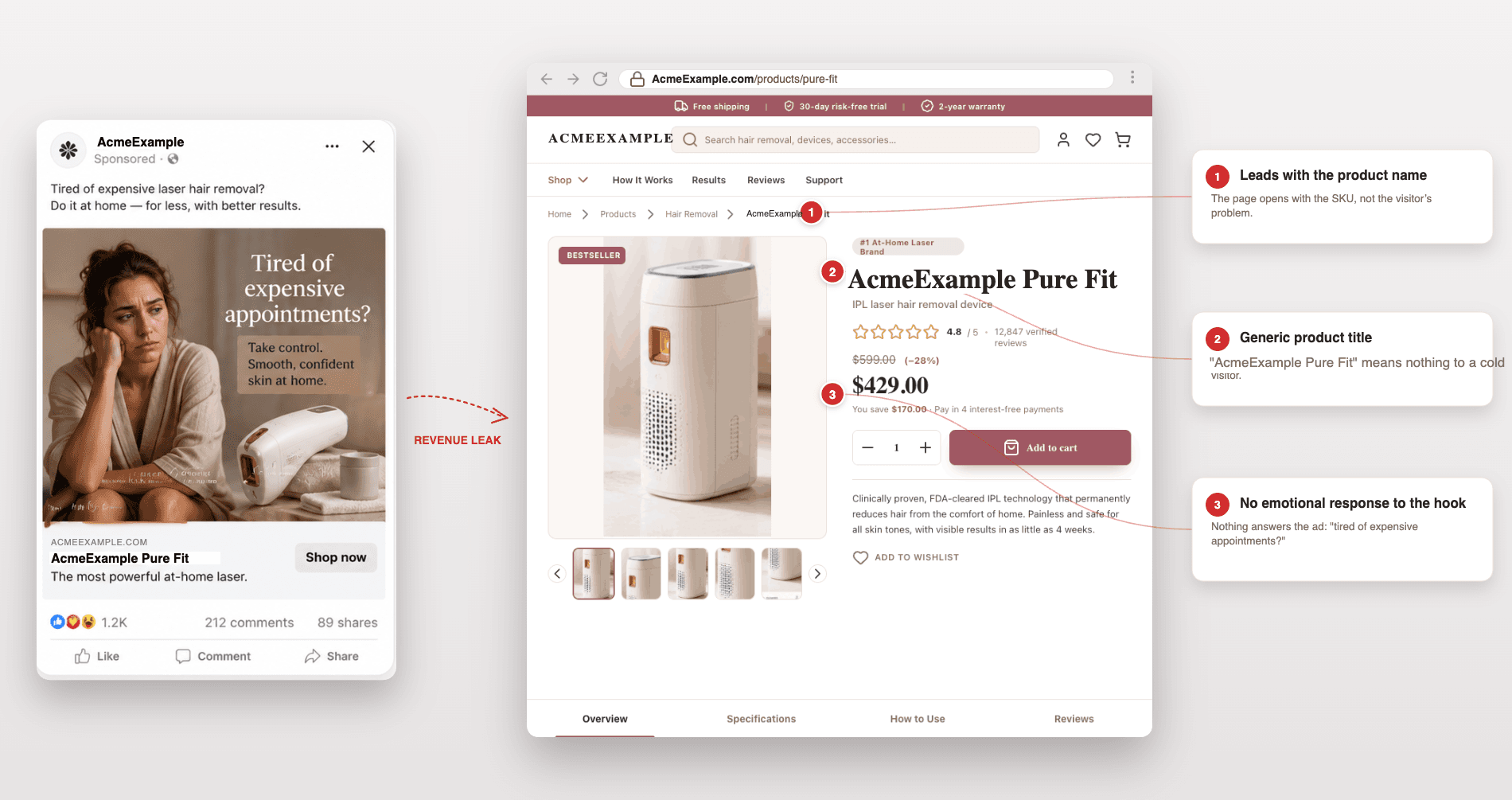
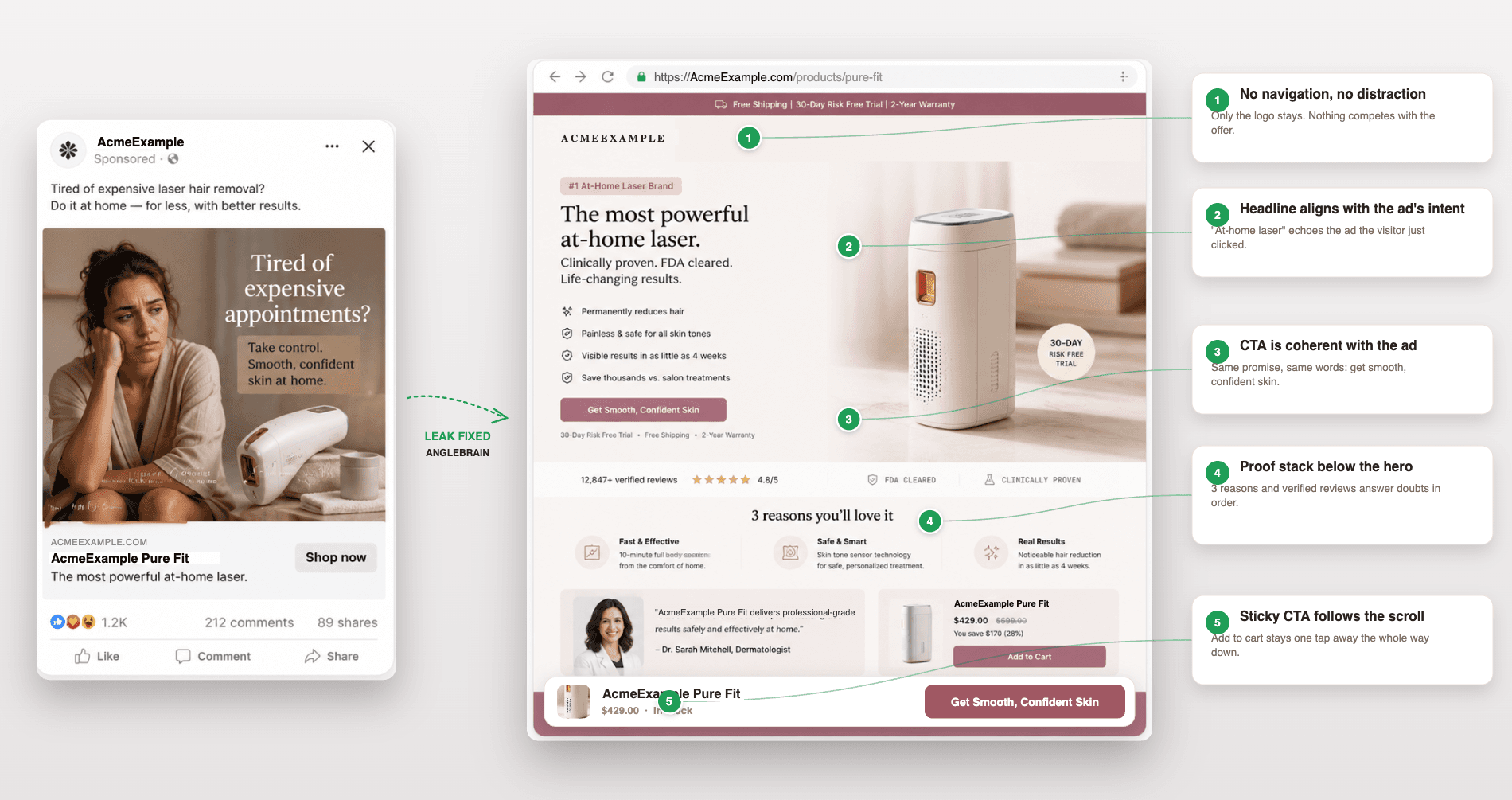
The match is the single highest-leverage thing in paid ecommerce. The ad sets an expectation in the first second of attention. If the page confirms it, the visitor keeps reading. If the page makes them re-derive the benefit from a product name or an ingredient list, most leave before they reach the proof that would convert them. A page can pass every generic CRO checklist, fast load, clean design, visible button, and still lose the sale because it answers a different question than the ad asked.
That is what this analyzer scores. It reads the ad's angle, then judges the page on message match, angle continuity, proof alignment, and friction, and shows you the exact line where the two stop agreeing.
 Click to zoom
 Click to zoom
Illustrative example. “AcmeExample” is a fictional brand used for demonstration only.
How top winning brands do this match
- They build a page per angle, not one page for every ad. Each winning creative points to an experience that continues its specific promise.
- They lead with the angle, not the catalog. The hero repeats the ad's exact words, so the visitor instantly knows they are in the right place.
- They match the proof to the claim. A clinical angle gets data, a transformation angle gets before-and-afters, a social-proof angle gets real reviews up top.
- They treat the page as a testable asset. They ship a small change, measure one metric, and let the winner compound, instead of guessing at button colors.